

The fastest-growing revenue teams in 2026 have quietly added a role that didn't exist on the org chart two years ago: the go-to-market engineer. GTM engineers aren’t a rep, marketer, or IT; they’re the person who turns buyer signals into an automated, deliverability-safe pipeline.
With how outbound has changed in recent years, that’s a very valuable proposition. At this point, growth is no longer about headcount. It's about whether you have someone engineering the system that makes each of your existing reps more productive.
Why more reps stopped working in outbound
For years, scale and success boiled down to increasing headcount to increase volume. Several shifts in outbound best practices have made this unfeasible.
In today’s ecosystem, adding SDRs adds linear cost and linear risk, and every new rep dilutes deliverability and quality. The market has punished brute-force volume with spam filters and buyer fatigue, so there’s a point of diminishing returns to adding people. It’s also a lot easier to hit that limit than it used to be.

Changes to the terms of service for both senders and recipients by major email providers have combined in a way where sending more emails will hurt deliverability. That means lower volume is the norm now. While there might be “cheats” and “hacks” to get around this, the risk-versus-reward for working around this system isn’t great. Ultimately, Google will figure out if you’re gaming their systems, and they will punish you harshly when that time comes.
LinkedIn is doing the same. New connection requests are being capped on both a per-day and per-week basis. This makes it harder to expand your network in a way that’s directly meant to make outbound harder.
Not only that, but pure volume just isn’t helpful. As outbound volume goes up, the quality of prospects goes down. The best-case scenario in most cases is that this translates to more meetings with bad fits and higher churn.
Whatever gains you might get in the short term will be significantly smaller than the long-term damage that comes as a result of these practices.
Growth now comes from leverage per rep, not from more reps. That’s where a GTM engineer can come through huge for your team.

What a GTM engineer actually does
A GTM engineer’s job is to take all of the information and data that flows through a company’s revenue engine and connect everything into a single, effective system. It’s a hybrid role that bridges the gap between commercial strategy and technical execution, increasing the efficiency and effectiveness of a revenue team.
The “engineer” label isn't just for show, either. Though they work as a member of the team, they’re not necessarily in a sales position and ultimately straddle the line between marketing and IT. It’s a data-centric role rather than a sales-focused one.
When done effectively, they help a revenue team shift into a higher gear than they would be able to otherwise. The goal is making a single, defined workflow out of what is normally an unintuitive process scattered across multiple disconnected tools.
In turn, this establishes triggers to automatically send the right message at the right time, which can greatly help SDRs. It’s a powerful tool that puts your team in a position to succeed.
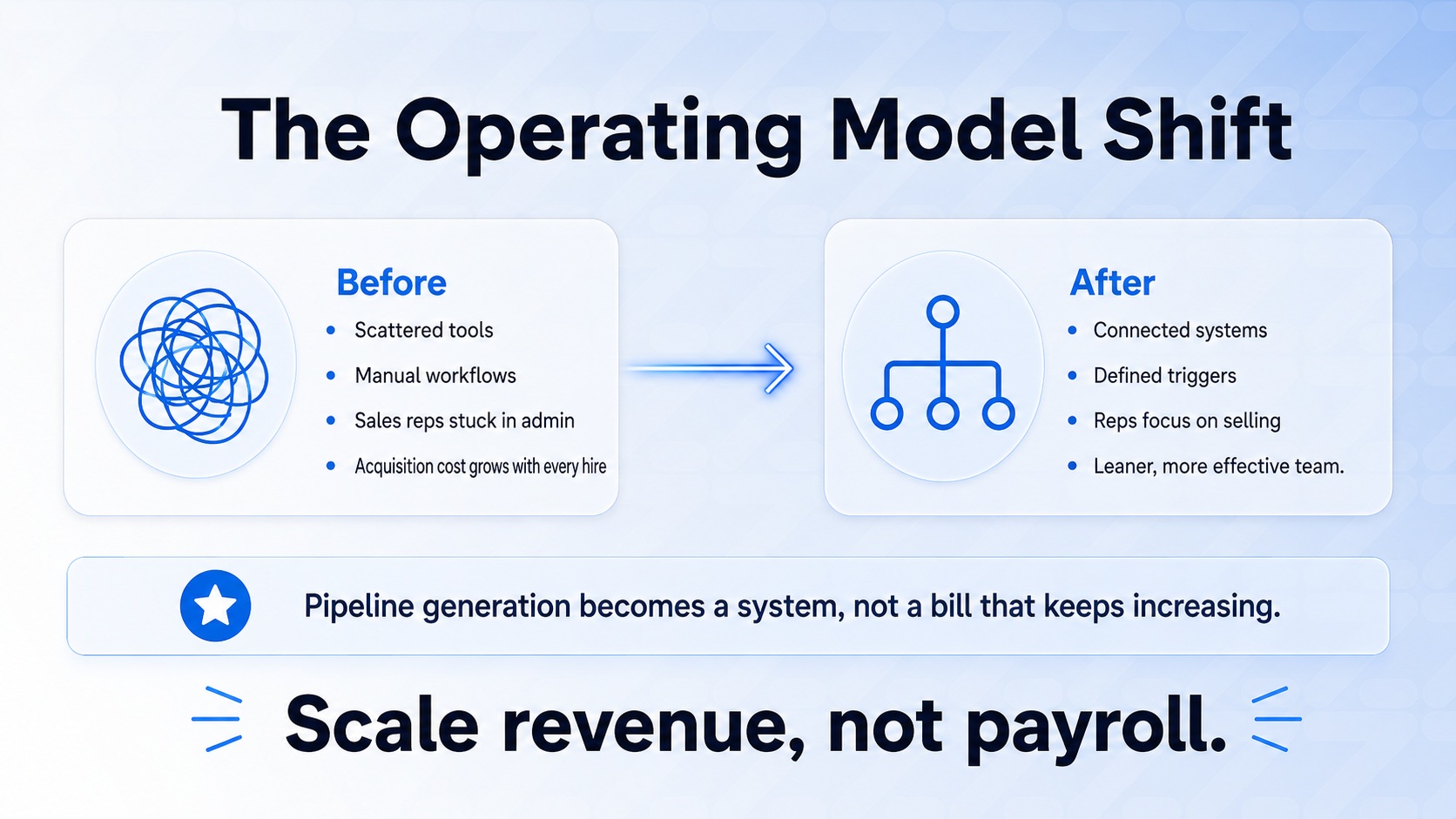
The operating model shift after adding a GTM engineer
If a GTM engineer is added to a team and does a good job, it can represent a significant shift in how RevOps work.
By successfully connecting disjointed systems and implementing defined triggers, sales reps can move on from list-building and admin and place greater emphasis on actual conversations and closing. Though using AI tools can help in this regard on their own, GTM engineers help to clearly identify the handoff point between automation and human SDRs.
This means that pipeline generation becomes a system you improve, rather than a bill that keeps increasing. Cost to acquire stops compounding with every hire, which means a leaner and more effective team.
How to start without a big team
At Zeekeo, we’ve worked with businesses of all sizes and we know how limited human resources can be in some cases. Even if the value of a GTM engineer lies in the ability to improve the effectiveness of a smaller team, it still ultimately translates to hiring someone. That’s a major hurdle for many.
The good news is that you don’t need to hire a specialist on day one. Your team benefits greatly from what a GTM engineer does, and a well-managed platform can deliver at least some of that.
So how do you do this?
Start by mapping your signals, then identifying your ideal accounts and highest-intent triggers. Come up with a system for integrating these together and establishing a system that lets you respond quickly and effectively.
When it comes to AI or other forms of automation, don’t put the cart before the horse. Establish your system and then integrate automation into it. Don’t build your system around the automation. The human premium is still high in outbound, and putting an AI tool at the top of the totem pole isn’t an ideal approach.
This process ultimately determines whether revenue scales or payroll does.
Even if you’d rather add another sales rep to your team over a GTM engineer, the days of volume-based outbound are dead. Limitations on how many emails you can send mean that all teams need to make their human resources more efficient, not bigger. The teams that build these systems will be the big winners of this decade, while the teams that keep hiring bodies will only fall behind further.
Book a Launchpad strategy session to see how a managed GTM engine can give you the capability without the headcount.
Subscribe to our blog
Lorem ipsum dolor sit amet, consectetur adipiscing elit. Pellentesque eget nunc finibus, venenatis purus eget, porta enim. Fusce a tempor diam, sed consequat purus.

Stefan Bako
Stefan Bako is the Customer Success Lead at Zeekeo where he helps businesses build stronger pipelines, create meaningful customer relationships, and turn growth strategies into measurable results. Working closely with clients, Stefan combines technology, data-driven insights, and a customer-first approach to help organizations achieve sustainable revenue growth. Outside of work, Stefan is passionate about travel, exploring new destinations with his family, hiking scenic trails, and spending time outdoors with his dog. He enjoys discovering new perspectives, whether through business, adventure, or the people he meets along the way.